
Free guidePDF · 99 pages · 75-minute read
When the Control Fails
A free 99-page LabLynx guide to quality control, proficiency testing and corrective action: what to do after a control, a PT sample or a result fails, and how to prove it was done.
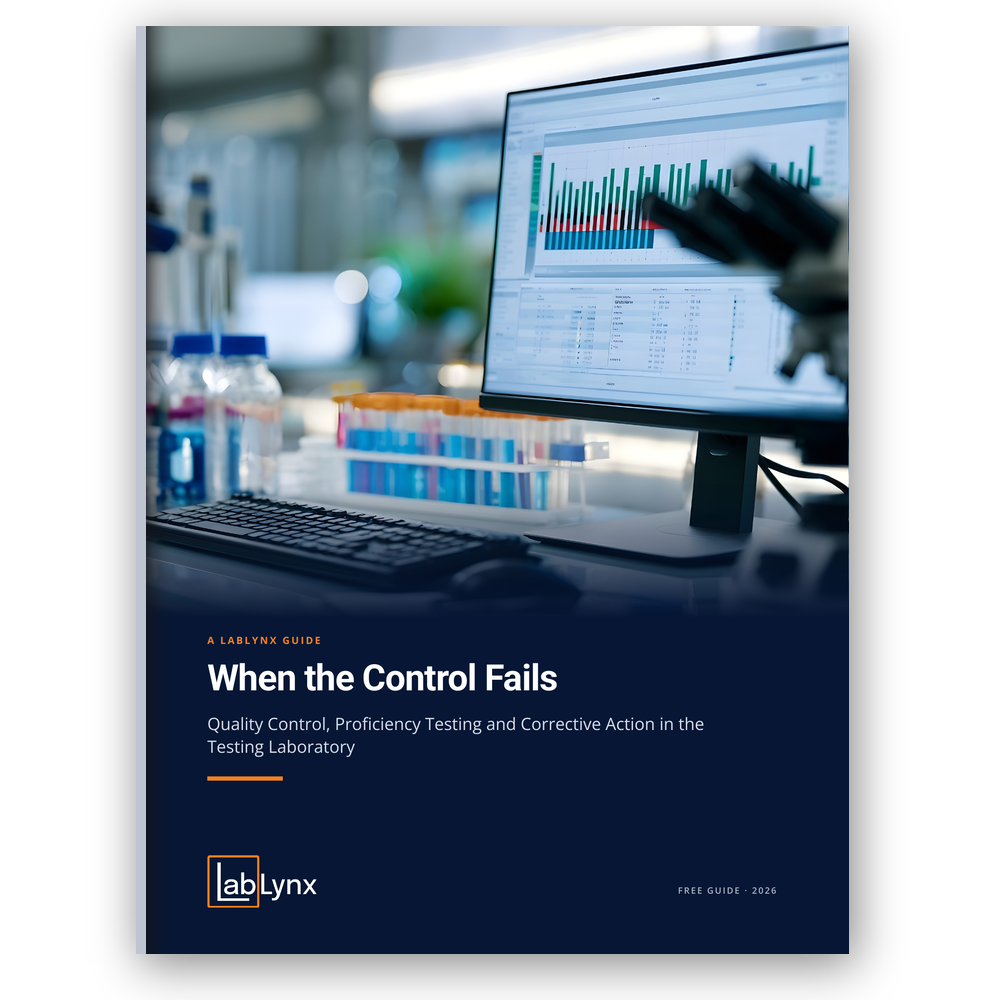
Get your free copy
- 99 pages
- Instant download
"*" indicates required fields
We also email you the link.
When a control fails, the laboratory has to answer six questions in order: did a rule fire, was release stopped, is it a real error or a false alarm, which results since the last good control are in question, what was corrected, and how will you know it worked. This LabLynx guide calls them the QC Event Ladder and shows what nine rulebooks require on each rung.
What you will learn
- Why a passing repeat proves less than it seems. In a CAP study of 505 hospital laboratories, more than 95% of out-of-control events were resolved simply by repeating the controls.
- The arithmetic of false alarms. A 1:2s rule with two controls rejects about 8.9% of runs on a bench where nothing is wrong. The guide turns that into a yearly False-Alarm Budget.
- Six rungs for the hour after a failure. Detect, Stop, Decide, Look back, Correct, Prove, with what the record holds on each and a score from 0 to 6.
- Which results a failure puts in question. The boundary is the last acceptable control, worked through for an analyzer run, an environmental batch and a calibration reference.
- Corrective action that stays closed. Correction versus corrective action, causes in the plural, why retraining is a weak fix, and the effectiveness check nobody schedules.
What is inside the guide
From the moment a control rule fires to the day the corrective action is proven to work: here is what the guide covers.
The repeat that passed
Most labs answer a failed control by repeating it. A repeat is fine under a written rule that keeps the first result; the silent repeat throws away what the failure was telling you.
Why good runs fail and bad runs pass
With two controls, a 1:2s rule rejects about one run in eleven on a healthy bench. The False-Alarm Budget turns that into a yearly count, and the rule is chosen per method.
Go deeper: Why alarm limits belong to the thing being measured
The QC Event Ladder
Six questions in order: Detect, Stop, Decide, Look back, Correct, Prove. Score any failure from 0 to 6; only a failure that could recur needs a corrective action.
Which results are in question
The boundary is the last acceptable control, because the onset of an error is rarely known. Worked for an analyzer run, an environmental batch and a calibration reference.
Go deeper: An instrument out of calibration should not be bookable
The Failure Crosswalk
Nine rulebooks side by side, rung by rung, from CLIA and ISO/IEC 17025 to environmental, drug, device and forensic rules. A lab under two should meet the stricter word on every rung.
Go deeper: The 2026 laboratory compliance calendar
When proficiency testing fails
What a failing score means in each scheme, why next round's pass is not the investigation, the order to check (clerical, handling, method, scheme), and the 2026 CLIA proposal.
Go deeper: CAP accreditation for laboratories
Corrective action that closes
A correction fixes this failure; a corrective action removes its causes. Retraining is the weakest common fix, and the effectiveness check needs a criterion and a date.
Go deeper: Five traceability mistakes that compromise quality investigations
The record, and the habit
What a QC event record must hold, why the audit trail is part of it, why labs keep repeating, and the ten-failure review that starts the change.
Go deeper: What a signed record should hold
Key takeaways
- A silent repeat throws away the one moment the lab learns what its results are worth. A repeat is fine when a written rule says how to read it and the first result stays.
- Every control rule trades false alarms against missed errors. Choose the rule per method, by its sigma metric.
- Every failure needs a decision and a record. Only one that could recur needs a corrective action.
- The look-back boundary is the last acceptable control, because the onset of an error is rarely known.
- A corrective action is finished when the failure has stopped, which is a different day from the one the form was signed.
The QC Event Ladder
Detect, Stop, Decide
Did a rule fire, was release held, and is it a real error or a false alarm? These belong to the first hour.
Look back
Which results since the last acceptable control are in question, and who has to be told?
Correct, Prove
What was fixed, could it happen again, and how will you know it worked?
This page is the summary. The full guide has the detail, all 99 pages of it.
PDF · 99 pages · 75-minute read. Free.
Who it is for
QC supervisors and senior analysts
who see failed controls every week and want a written answer for each one that holds up later.
Quality and technical managers
who own the corrective-action log, the PT file and the next assessment under one or more rulebooks.
Lab directors
who sign for the results and need to know which ones a failure puts in question.
Written for Testing labs of every kind: clinical and public health, environmental and water, food, pharmaceutical and manufacturing quality control, calibration, forensic and research labs.
What should a lab do when a QC control fails?
Is it wrong to repeat a failed control?
Does every failed control need a corrective action?
Which patient or sample results does a failed control put in question?
Does a pass in the next PT round close a PT failure?
Does the guide recommend any software?
More free guides
 Free guideThe Laboratory Handoff ProblemA plain-language guide to every place laboratory work changes hands, from the customer's request to the report and between every system: where errors, delays and lost information begin, and why the first fix is to remove a handoff, not to automate it.Get this free guide
 Free guideWhere Did the Other 44 Hours Go? Finding and Reducing Laboratory Turnaround TimeA plain-language guide to laboratory turnaround time: why a lab can have fast testing and slow results, how to split turnaround into work, waiting and rework, read its spread instead of its average, and find and get back the hours lost between sample receipt and final report.Get this free guide
 Free guideHow to Build a Laboratory System That Gets Better as Your Lab GrowsA free 97-page LabLynx guide to what happens after a laboratory system goes live: how the gap opens between what the lab needs and what the system was set up for, how to read it in your workarounds, whether you have outgrown the platform, the implementation or the process, and how to close it.Get this free guide
Free guide
When the Control Fails
PDF · 99 pages · 75-minute read
- Why a passing repeat proves less than it seems
- The arithmetic of false alarms
- Six rungs for the hour after a failure