
Free guidePDF · 103 pages · 100-minute read
Where Did the Other 44 Hours Go? Finding and Reducing Laboratory Turnaround Time
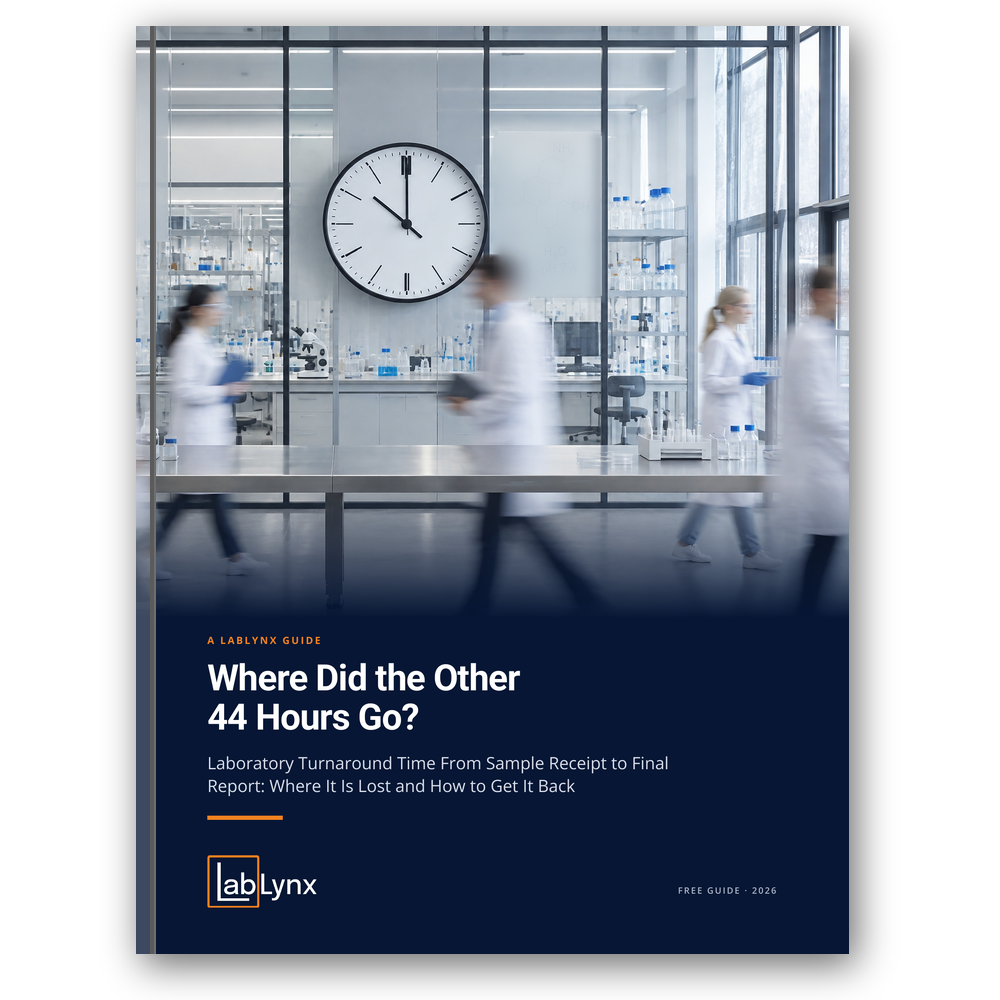
A free 103-page LabLynx guide to laboratory turnaround time, from sample receipt to final report, and how to find and get back the hours lost in between.
Get your free copy
- 103 pages
- Instant download
"*" indicates required fields
We also email you the link.
Laboratory turnaround time is the time from one agreed moment in a sample's life to another, usually from receipt to the moment the customer has the result. This LabLynx guide shows that it is testing time plus everything between the steps, and teaches labs to split it into work, waiting and rework, find the largest gaps and get the lost hours back.
What you will learn
- Where the time really goes. The test is usually the small part; most of the rest is waiting between steps.
- How to measure turnaround honestly. Nine timestamps, a written start and stop, and the median and 90th percentile instead of the average.
- Six names for lost time. The TAT Loss Map: queue, handoff, information, processing, exception and review loss.
- Which fixes have measured effects. Published fixes, each matched to the kind of lost time it removes, and the ones that bought little.
- How to find your own lost hours. A timestamp exercise with 10 to 20 samples, a 90-day plan and five printable worksheets.
What is inside the guide
From the receiving bench to the customer's inbox, and every hour in between: here is what the guide covers.
Turnaround time is more than testing time
If the test takes four hours but the result takes two days, the question is where the other 44 hours went. In published studies the test was often the small part: 20 minutes of a 92-minute wait in one emergency department. Turnaround time is testing time plus everything that happens between the steps.
Go deeper: The high cost of a slow lab
Whose clock?
Every turnaround number runs between two moments, and the lab, the customer and the regulator often choose different ones. Most rulebooks ask for timely results and leave the number to the lab. The guide names nine timestamps, from Received to Delivered, and shows how to write a target: X% within Y, from A to B.
Read the spread, not the average
Most samples finish near the fast end and a few trail far behind, so the average describes almost none of them. Report the median for the normal day, the 90th percentile for the bad day and the share within target, and read the late samples one by one.
Work, wait, rework
Every hour of turnaround is work, waiting or rework, and of the work the guide asks one more question: is it necessary? Waiting grows faster and faster as people and instruments get busier, and the calendar, with its nights, weekends and worklists, is often the biggest queue.
The TAT Loss Map
Lost time comes in six kinds: queue, handoff, information, processing, exception and review loss. Each shows up in particular gaps between timestamps and needs its own family of fixes, so "we are too slow" becomes "most of our lost time is review loss".
Receipt and assignment
The front door is fast work surrounded by long waits, and most turnaround reports start too late to see them. Record the received time when the sample arrives, decide in advance which missing fields stop work, and assign at login so a sample does not lose a night waiting for the next worklist.
Go deeper: Chain of custody for environmental labs
The queue, the analysis and the exceptions
The analysis is the part labs understand best, and the queue in front of it is the part that grows. Copying results between systems is work nobody needs and it breeds errors, and every exception needs someone who notices, someone who is told and someone who decides.
Review and approval
Testing complete is not a result: the wait for a signature can be most of the turnaround. Give review a fixed slot placed just after results arrive, push the pending list every day, spread the reviewer role, and let tested rules release the results that pass.
Reporting and delivery
The clock stops when the customer has the result, and signed, sent, received and read are different moments. Build the report from the record, choose the fastest channel the customer can receive, and confirm urgent results instead of assuming they arrived.
Go deeper: Laboratory reporting
Find your lost time and get it back
Rebuild nine timestamps for 10 to 20 recent samples, find the largest gaps before you ask why, and match each fix to the loss it removes. In the published studies the big gains attacked waiting, so try the cheap fixes first and measure again: the bottleneck moves.
Go deeper: Dashboards and data visualization for lab decisions
Key takeaways
- Turnaround time is more than testing time. It is testing time plus everything that happens between the steps.
- Split it three ways. Every hour is work, waiting or rework; the target is the time in which nothing useful is happening to the sample.
- Read the spread, not the average. Use the median for the normal day, the 90th percentile for the bad day, and look at every late sample one by one.
- Name the lost time. Queue, handoff, information, processing, exception and review loss each need their own family of fixes.
- Fix the delay you found. Aim each fix, and any automation, at the largest gap, then measure again: the bottleneck moves.
The timestamp exercise in six steps
Pick 10 to 20 recent samples. Include some that missed their target and a few ordinary ones.
Rebuild the nine timestamps. From Received to Delivered, using the lab's system, instrument files, emails and paper.
Check that the times run in order. Missing and backwards times are a finding in themselves.
Work out each sample's own gaps. Summarize only after that, and never add up medians.
Name the loss in each gap. Ask what the sample was waiting for.
Find the largest gaps before you ask why. Then fix the biggest one and measure again.
This page is the summary. The full guide has the detail, all 103 pages of it.
PDF · 103 pages · 100-minute read. Free.
Who it is for
Lab managers and directors
who are asked "where is my result?" and decide where the lab's time and money go.
Quality and compliance leads
who own review, approval and the clock the lab reports to its customers.
Scientists, technicians and the people who run the lab's data
who live with the queues every day and hold the timestamps that show where the hours go.
Written for Testing labs of every kind: clinical and public health, environmental, food, pharmaceutical and manufacturing quality control, forensic and research labs.
Why does the guide say a lab can have fast testing and slow turnaround?
What does the guide mean by work, wait and rework?
How does the guide recommend reporting turnaround time?
What are the six kinds of lost time in the guide's TAT Loss Map?
Why does the guide warn against buying a faster instrument first?
Where does the guide suggest a lab start?
More free guides
 Free guideThe Ultimate Guide to Smarter Sample ManagementDiscover how leading labs are transforming sample handling with smarter strategies and modern tools. This guide explores practical ways to eliminate sample loss, streamline storage, improve traceability, and future-proof operations with LIMS, automation, and integrated workflows.Get this free guide
 Free guideThe AI-Ready Laboratory: A Decision-Maker’s Guide to Building Smarter, Faster, More Profitable Lab OperationsLearn how forward-thinking laboratories are using AI, machine learning, and predictive analytics to cut costs, strengthen compliance, and scale operations without proportional headcount increases. This guide provides decision-makers with ROI models, governance frameworks, and a phased implementation roadmap for building an AI-ready laboratory powered by modern LIMS infrastructure.Get this free guide
 Free guideThe Ultimate Guide to Laboratory ComplianceNavigate the complex world of lab regulations with confidence. This guide breaks down key standards across industries including clinical, pharma, food, and environmental, helping labs stay audit ready, improve quality, and protect data. It is a must-have resource for building a safer, smarter, and fully compliant lab operation.Get this free guide
Free guide
Where Did the Other 44 Hours Go? Finding and Reducing Laboratory Turnaround Time
PDF · 103 pages · 100-minute read
- Where the time really goes
- How to measure turnaround honestly
- Six names for lost time