
Free guidePDF · 97 pages · 70-minute read
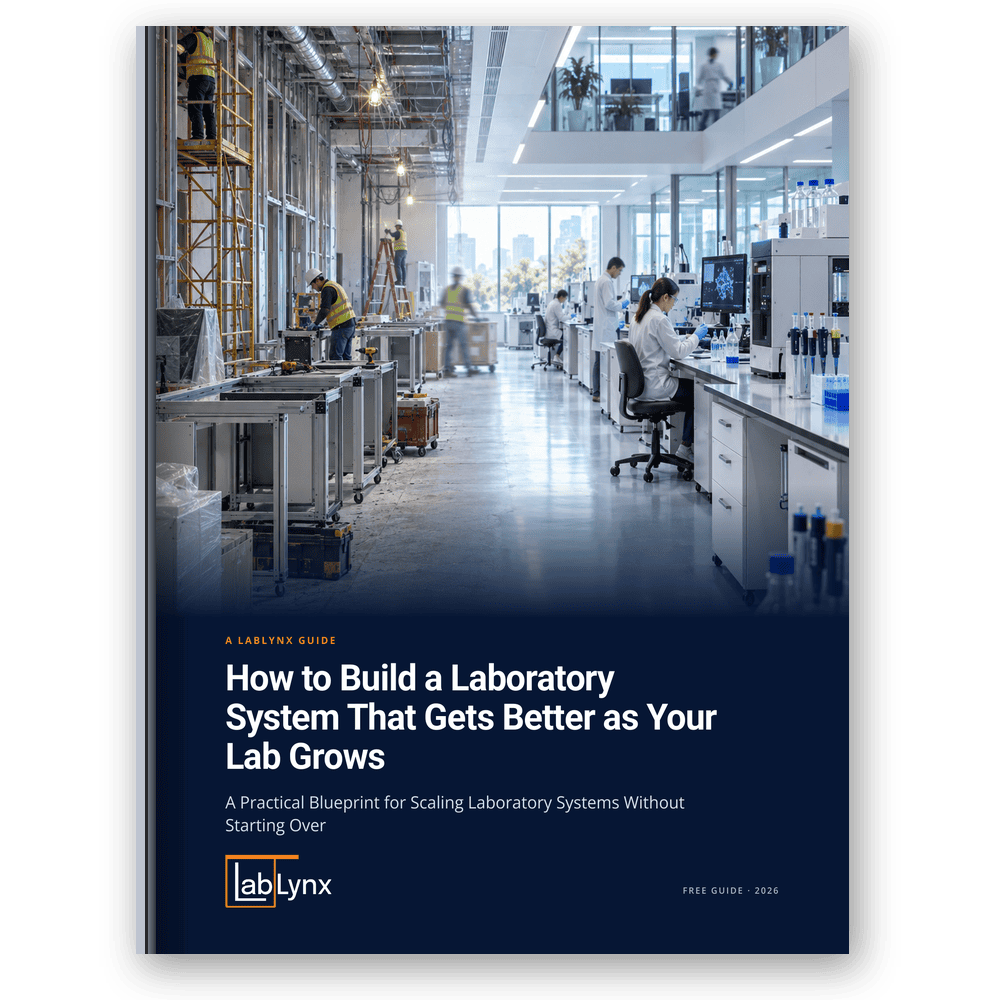
How to Build a Laboratory System That Gets Better as Your Lab Grows
A free 97-page LabLynx guide to what should happen after go-live, from the first workaround to the decision to optimize or replace.
Get your free copy
- 97 pages
- Instant download
"*" indicates required fields
We also email you the link.
The Laboratory System Growth Gap is the difference between how a laboratory needs to operate today and what its laboratory management environment was originally configured to support. This LabLynx guide shows how the gap opens after go-live, how to read it in your workarounds, how to tell whether you have outgrown the platform, the implementation or the process, and how to close it.
What you will learn
- Why go-live is the middle, not the end. The benefits of a system are only knowable in the years after launch, which most laboratories never staff.
- How to read the gap in your workarounds. A Workaround Register with four verdicts: Keep, Absorb, Redesign or Escalate.
- Three questions, in the order that costs least. Should this work happen at all? Can the system already do it? Only then: can this platform ever do it?
- What to connect, automate and standardize, and what to leave alone. Where people are still the integration, what has become predictable enough to automate, and what must stay local across sites.
- An annual review and an honest optimize-or-replace decision. Nine review areas that fit inside the management review you already hold, and a scorer adapted from a national audit office.
What is inside the guide
From the day the system goes live to the day someone asks for a quote to replace it: here is what the guide covers.
Go-live is the middle
The day a laboratory system goes live is the moment the real design work starts, not the finish line. The benefits of a large system can only be judged in the phase after everyone stops paying attention, and that phase is the one most organizations never staff. When a national audit office checked, none of 24 agencies fully met a legal requirement for an annual review of their technology.
The Laboratory System Growth Gap
The lab keeps changing; the configuration mostly does not, because research found a window after installation, as brief as two to three months, in which a system can still be changed before it congeals. The space between what the lab needs and what the system was set up for fills with spreadsheets, email, shared drives and one person's memory. You do not measure the gap; you look at what is filling it.
Follow the workarounds
A repeated workaround is often an undocumented system requirement. Nobody has ever counted workarounds in a laboratory, so the guide brings the rigorous hospital research to labs and turns it into a Workaround Register with four verdicts. It also gives spreadsheets an honest hearing: in one audit 86% of operational spreadsheets had a wrong result, yet 40% of those errors changed nothing, and a European regulator's published answers set conditions for spreadsheets, not a ban.
Go deeper: When a lab is too big for spreadsheets
Platform, implementation or process?
Three questions, asked in a fixed order: should this work happen at all, the way it is done now; can the system already do it, including what you never switched on; and only then, can this platform ever do it. Most laboratories ask the third question first, and it is the most expensive question in the building. A six-part health check then reads the state of your system from answers you can look up rather than opinions you can argue about.
Go deeper: LIMS customization vs. configuration
Optimize before you expand
Standardize before you integrate; optimize before you automate. One team standardized its fields and deleted its dead reports before automating anything, because automating waste gives you automated waste. A two-week optimization event, a clinic's first in the seven years since go-live, gave each clinician about 20 minutes a day back, and the gain wore off within a year, which is why the guide's answer is a habit rather than a project.
Go deeper: Laboratory change management
Where are people the integration?
Read, copy, paste, upload, email: wherever that sequence appears, a person is acting as an interface. In one published case an interfaced instrument still had its results retyped by hand because billing needed a field the interface never carried, and 3.7% of the retyped results differed from what the instrument had sent. The guide also explains why both original instrument-interface standards were withdrawn in 2002 and what a connection costs once you have it.
Automate what has become predictable
Automation should follow process understanding, not replace it. The guide gives a published suitability checklist, the break-even arithmetic, and the evidence that automating a judgment invites people to click past it. What should stay manual gets its own section: low volume, high judgment, or work that changes too often to be worth building.
Go deeper: Which lab processes pay to automate
Scale without multiplying complexity
Every growth event costs the system something specific: a new site needs its own certificate and its own proficiency testing; competency records scale as analysts times methods, not headcount. An accreditation body has already written down which functions must stay central. And over-standardizing has a cost too: one three-site network harmonized a code list and broke the automation that had been quietly built on the old local codes.
Go deeper: LIMS scalability
Turn the system into a management tool, and review it every year
A mature system answers nine management questions without anyone walking the lab, and its own audit trail already records where people are leaving it. The annual review does not need a new meeting: six authorities already require most of its nine items, and the guide puts them in one table. It also shows why reviewing on its own changes little, and who owns the answer when the lab and IT disagree.
Go deeper: Dashboards and data visualization for lab decisions
Optimize or replace, and the next five years
Sometimes replacement is right: unsupported technology and unfixable defects are real reasons, and a government rule says so. But replacement takes far longer than anyone plans, the old system cannot be switched off while retention rules run, and a replacement that reproduces your configuration has moved your gap, not closed it. A scorer adapted from a national audit office and an illustrative five-year roadmap close the guide.
Go deeper: LIMS data migration
Key takeaways
- Go-live is the beginning of the system's life, not the end. The benefits can only be judged in the years afterwards, which most labs never staff.
- The lab changes faster than its original implementation unless someone deliberately maintains and expands the system.
- Repeated workarounds are evidence that something has changed. Collect them, and give each a verdict: Keep, Absorb, Redesign or Escalate.
- Before replacing a system, work out whether the problem is the platform, the implementation or the workflow. Ask the three questions in that order.
- The goal is not a system that still works in five years. It is a system that works better in five years.
The three questions, in order
1. Should this work happen at all, the way it is done now?
If not, the answer is process redesign, and it costs nothing but agreement.
2. Can the system already do it?
Asked honestly, including the modules you bought and never switched on.
3. Only then: can this platform ever do it?
Answered with evidence, not a feeling. Most laboratories never reach this question.
This page is the summary. The full guide has the detail, all 97 pages of it.
PDF · 97 pages · 70-minute read. Free.
Who it is for
Lab managers and directors
who have been asked for a quote to replace the system and want to know whether the lab has really outgrown it.
Quality, operations and informatics managers
who own the workflows, the accreditation and the management review, and decide what the system should do next.
Owners of growing independent labs and multi-site leaders
who are adding tests, instruments, people and sites and want the system to keep up without starting over.
Written for Testing labs of every kind: contract, environmental, food, pharmaceutical and manufacturing quality control, clinical and public health, forensic and research labs.
What does the guide mean by the Laboratory System Growth Gap?
How does the guide tell a platform problem from an implementation problem from a process problem?
Is the guide against spreadsheets?
How often does the guide say a laboratory should review its system?
When does the guide say a laboratory should replace its system rather than improve it?
What does the guide suggest a laboratory do first?
More free guides
 Free guideThe Laboratory Workflow Automation LadderA plain-language guide to the six levels of lab workflow automation, from manual handoffs to autonomous operations. See where each workflow stands, what every level gets right and where it breaks, and use the Ceiling Matrix and three worksheets to plan your next step safely.Get this free guide
 Free guideThe Laboratory Handoff ProblemA plain-language guide to every place laboratory work changes hands, from the customer's request to the report and between every system: where errors, delays and lost information begin, and why the first fix is to remove a handoff, not to automate it.Get this free guide
 Free guideWhere Did the Other 44 Hours Go? Finding and Reducing Laboratory Turnaround TimeA plain-language guide to laboratory turnaround time: why a lab can have fast testing and slow results, how to split turnaround into work, waiting and rework, read its spread instead of its average, and find and get back the hours lost between sample receipt and final report.Get this free guide
Free guide
How to Build a Laboratory System That Gets Better as Your Lab Grows
PDF · 97 pages · 70-minute read
- Why go-live is the middle, not the end
- How to read the gap in your workarounds
- Three questions, in the order that costs least