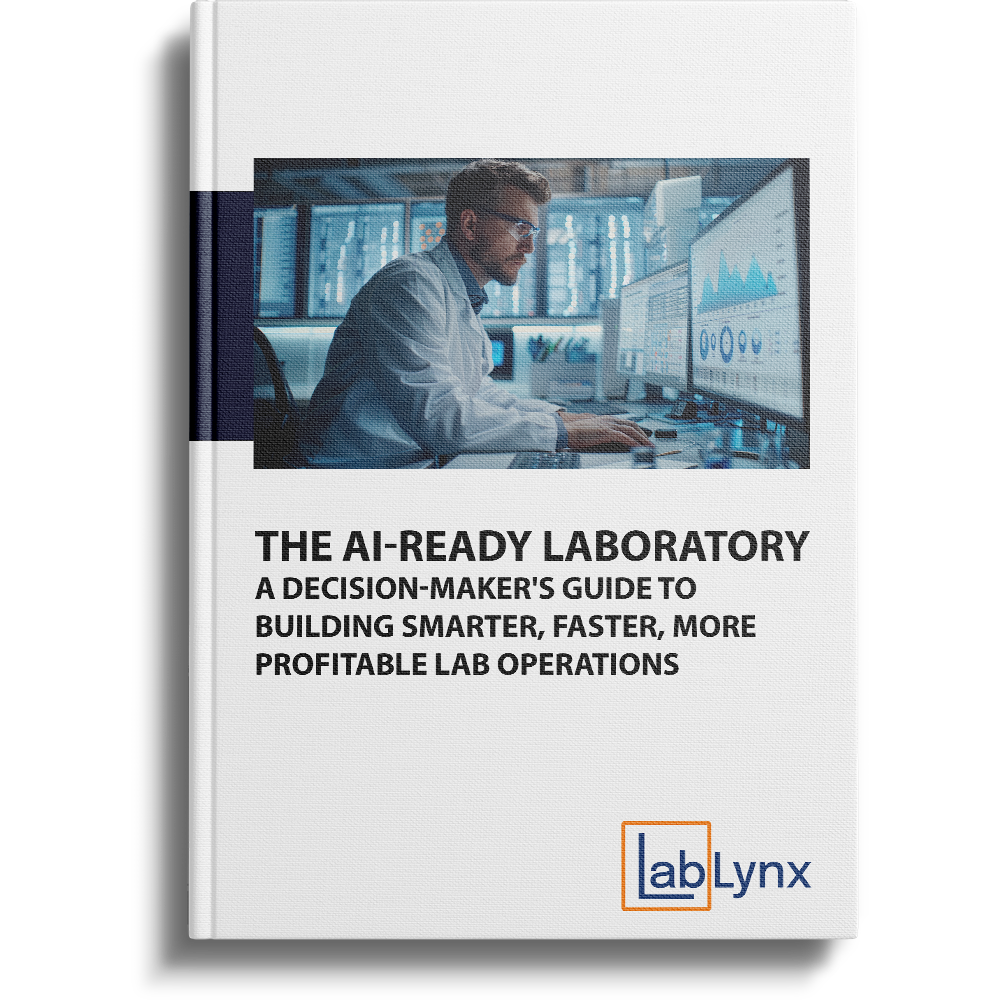
Free guidePDF · 29 pages · 30-minute read
The AI-Ready Laboratory: A Decision-Maker's Guide to Building Smarter, Faster, More Profitable Lab Operations
A free 29-page LabLynx guide to AI in the laboratory, from the hidden cost of manual work and the data AI depends on to governance, ROI and a five-step roadmap.
Get your free copy
- 29 pages
- Instant download
"*" indicates required fields
We also email you the link.
An AI-ready laboratory is one built on structured, centralized, well-governed data that AI can use: sample records, instrument results and audit trails in one place, under clear policies. This LabLynx guide shows decision-makers what AI can do in a lab today, what waiting costs, how to govern it, and a five-step roadmap to get there.
What you will learn
- What operating without AI really costs. Five cost categories, from retests and slow turnaround to staff burnout and missed growth.
- What AI can and cannot do in a lab today. Workflow automation, predictive maintenance, anomaly detection and compliance monitoring, with people kept in the loop.
- Why the data has to come first. The structured, connected records every AI project depends on, and the order to build them in.
- How to govern AI and choose a partner. A five-part governance framework and the questions to put to any AI vendor.
- A business case and a roadmap. Four steps to a defensible business case, and five steps from a maturity check to scaling what works.
What is inside the guide
From what manual work really costs to a phased plan for your own lab: here is what the guide covers.
The hidden cost of operating without AI
Manual data entry, disconnected instruments, paper logs and reactive maintenance cost labs money that is spread across departments, so it rarely gets added up. The guide sorts it into five categories: errors, turnaround delays, compliance remediation, staff burnout and turnover, and opportunity cost. The staffing shortage makes every one of them worse.
Go deeper: Reducing human error in the lab
What AI actually means for your laboratory
Machine learning, natural language processing, computer vision and predictive analytics, and what each one does in a working lab. What AI can do right now, from workflow automation and predictive maintenance to anomaly detection, and why the strongest results keep people in the loop.
Go deeper: AI agents in the lab
The data foundation: why AI fails without it
AI is only as good as the data it runs on, and lab data is often scattered across spreadsheets, paper logs and proprietary instrument outputs. The guide sets out the digital backbone AI needs (structured sample records, standardized metadata, integrated instrument data, complete audit trails and central storage) and the four-stage path from digitizing to deploying AI.
Go deeper: Laboratory informatics: five kinds of data
AI-powered compliance: from audit anxiety to audit confidence
In a manual lab, audit preparation takes weeks of pulling and reconciling records. The guide shows how continuous monitoring, automatic audit trails, real-time deviation alerts and on-demand reports keep a lab ready for an audit at any time, and what to ask before AI touches protected health information.
Go deeper: Preparing your lab for an inspection
Intelligent workflows: automation that thinks
Traditional automation follows fixed rules; intelligent automation weighs workload, priority and instrument performance before it routes a sample. See how that applies from intake and instrument scheduling to bottleneck detection, result validation and reporting, and why it lets throughput grow without the same growth in headcount.
Go deeper: Lab automation: which processes pay
AI security and data governance in the lab
AI brings risks that traditional lab IT does not: re-identification of de-identified data, algorithmic bias, black-box decisions and a wider attack surface. The guide gives a five-part governance framework and the questions to ask any AI vendor about compliance, data residency, model transparency, track record and support.
Go deeper: Laboratory data privacy in the age of AI
Measuring the ROI of AI in lab operations
Returns fall into four pillars: cost reduction, revenue enablement, risk mitigation, and capacity growth without proportional hiring. A four-step business case follows: baseline current costs, model conservative improvements, calculate the payback period and three-year ROI, and quantify the cost of waiting.
Go deeper: How to build a business case for a LIMS
Building your AI-ready laboratory: a step-by-step roadmap
Five steps, from an honest assessment of digital maturity and a sound data foundation to one or two AI pilots with clear success metrics. Then choose partners for the long term, implement in phases, measure relentlessly and scale what works.
Go deeper: The laboratory technology maturity framework
Key takeaways
- The cost of standing still is real, but hidden. Manual data entry, disconnected instruments and reactive maintenance show up as retests, delays, overtime and lost client confidence, spread across budgets where few labs ever add them up.
- AI augments people; it does not replace them. The guide's model is human-in-the-loop: AI handles volume, speed and pattern recognition, and your team handles judgment, interpretation and innovation.
- Data comes before AI. Without structured, standardized, centralized data, even advanced algorithms produce unreliable results, and often confidently wrong ones.
- Govern AI before you deploy it. Name an owner, define approved uses, set vendor criteria, limit data access to the minimum necessary, and plan for AI failures.
- Build the business case on your own baseline. Document what manual work, errors, turnaround and audit preparation cost today, model improvements conservatively, and count the cost of waiting.
The five-step roadmap
Assess your current digital maturity. Check data accessibility, instrument connectivity, workflow standardization, compliance readiness and data governance.
Establish your data foundation. Standardized sample identification and metadata, integrated instruments, central storage with role-based access, full audit trails and written data governance policies.
Identify high-impact AI pilot projects. Start with one or two use cases, such as compliance monitoring, predictive maintenance, sample routing or anomaly detection, and define success metrics first.
Select the right technology partners. Weigh laboratory domain expertise, compliance readiness, scalability and integration, security, support and training, and long-term viability.
Implement in phases, measure relentlessly and scale what works. Name a project champion, gather feedback from front-line staff, and track turnaround, errors, staff hours, audit performance, cost per test and capacity use.
This page is the summary. The full guide has the detail, all 29 pages of it.
PDF · 29 pages · 30-minute read. Free.
Who it is for
Lab directors and managers
who are weighing a first AI pilot and need to know what AI can deliver in a lab today, and what it cannot.
CFOs and budget committees
who want ROI projections, a payback period and a business case built on the lab's own numbers before approving an investment.
Compliance officers
who must assess the risk of AI-enabled workflows, from data privacy and HIPAA to audit trails and governance.
Written for Clinical and healthcare, environmental testing, biotech, forensic, research and commercial testing labs.
What does the guide say AI can and cannot do in a lab today?
Why does the guide say AI fails without a data foundation?
How does the guide recommend governing AI in the lab?
How does the guide suggest building a business case for AI?
Where does the guide suggest a lab start with AI?
What does the guide say to ask an AI vendor?
More free guides
 Free guideJustifying LIMS Acquisition and Deployment within Your OrganizationNeed approval for a new laboratory information management system? This free guide shows how to tie the project to your organization's goals, weigh on-premises and cloud costs, show tangible and intangible benefits beyond ROI, and win management buy-in, with a workbook for building your pitch.Get this free guide
 Free guideThe Ultimate Guide to Laboratory ComplianceNavigate the complex world of lab regulations with confidence. This guide breaks down key standards across industries including clinical, pharma, food, and environmental, helping labs stay audit ready, improve quality, and protect data. It is a must-have resource for building a safer, smarter, and fully compliant lab operation.Get this free guide
 Free guideComprehensive Guide to Developing and Implementing a Cybersecurity PlanWriting a cybersecurity plan for your lab? This free guide covers the regulatory frameworks and NIST standards that apply to laboratory data, a ten-step planning method, and an appendix mapping the NIST SP 800-53 control families, so lab leaders can protect sensitive data and stay compliant.Get this free guide
Free guide
The AI-Ready Laboratory: A Decision-Maker’s Guide to Building Smarter, Faster, More Profitable Lab Operations
PDF · 29 pages · 30-minute read
- What operating without AI really costs
- What AI can and cannot do in a lab today
- Why the data has to come first