
Free guidePDF · 75 pages · 65-minute read
The Laboratory Workflow Automation Ladder
A free 75-page LabLynx guide to the levels of laboratory automation, from finding each workflow's level to a first climb you can start next week.
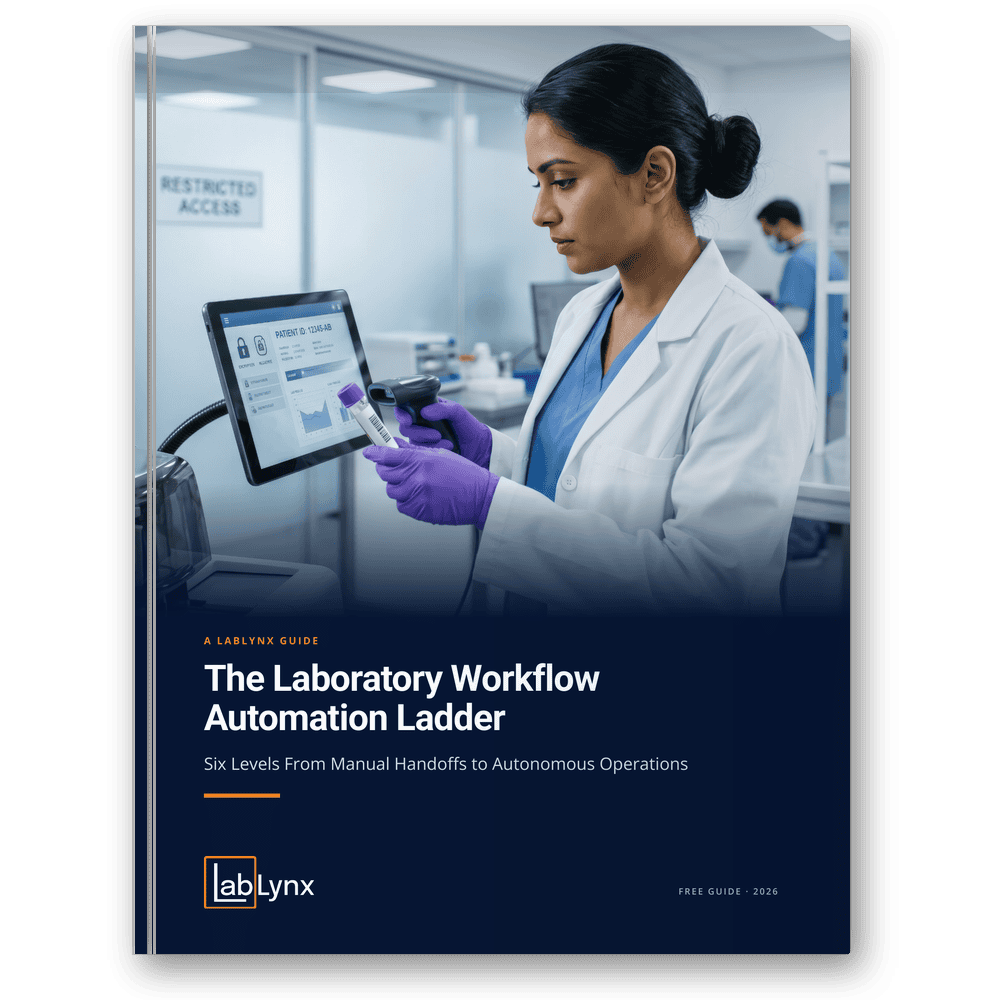
Get your free copy
- 75 pages
- Instant download
"*" indicates required fields
We also email you the link.
Laboratory workflow automation is a decision about who, or what, carries each handoff in a lab, and who decides what happens next. This LabLynx guide sorts it into six levels, from Level 0, where people, paper and memory carry everything, to Level 5, where a system would plan its own next step, and shows how to climb one rung at a time.
What you will learn
- Where labs really lose time and make mistakes. In the handoffs between people, paper and systems, not inside the instruments.
- The six levels of automation. From manual work to autonomous operations, each one defined by the person's job.
- How high each workflow should climb. The Ceiling Matrix weighs what a wrong call costs against how easily it is caught.
- How to climb safely and prove it worked. Trustworthy data, testing for your own use, and measures taken before and after.
- A first climb you can start next week. Six steps, a 90-day plan and three printable worksheets.
What is inside the guide
From the handoffs where labs lose time to a first climb you can start next week: here is what the guide covers.
Every lab is a chain of handoffs
The instruments are rarely the weak link: most errors happen in the handoffs before and after them. A handoff fails in four ways: the work is lost, changed, late or stripped of its meaning. Automation is a decision about who, or what, carries each handoff, and who decides what happens next.
Go deeper: Reducing human error in the lab
Six levels, one ladder
Each rung is defined by the person's job, not by how clever the machine is, an idea borrowed from the driving levels. The bright line sits between Level 2 and Level 3, where the system starts to decide within a tested scope. A level belongs to one workflow, so your lab has a profile, not a score.
Levels 0 and 1: manual work and digital islands
At Level 0, people, paper and memory carry every sample and number, which works until attention slips. At Level 1, every step has a computer, but a person carries the data between them, and spreadsheets quietly change it. Make the paper safe first, then give each sample one ID and connect the busiest handoff.
Go deeper: Manual lab tasks to hand off first
Level 2: connected
One record follows each sample, barcodes replace typed IDs, and instruments send results back without retyping, while a person still decides every result. Connected is not the same as understood: codes, units and context must be agreed, or data arrives stripped of meaning. Someone now checks the pipe instead of retyping what flows through it.
Go deeper: Lab instrument integration
Level 3: rule-driven
Within a tested scope, rules release routine results and hold the rest for a person, like a spam filter; clinical labs call it autoverification. The human job changes rather than shrinks: fewer reviews but harder ones, plus owning and testing the rules. Rules are software, so test them on your own data and count the alerts they raise.
Levels 4 and 5: predictive and autonomous
At Level 4 the system acts on its forecasts within limits people write down, and the careful start is to let the model recommend while a person decides. The promising results are mostly simulated or looking back: published is not deployed. At Level 5, research robots choose their own next experiment on narrow questions, but no lab has handed a whole workflow to one.
Go deeper: AI agents in the lab
Climb safely
Every rung rests on data you can trust, systems tested for your own use and people who stay sharp. Give everyone their own login, keep the audit trail on and out of reach, and test harder as human review shrinks. Fix the process first, then climb one rung and one workflow at a time.
Go deeper: What each regulator asks for in validation
How high to climb, and how to know it worked
A level is an upper limit, not a target: the Ceiling Matrix sets it from what a wrong call costs and how easily it is caught and put right. Measure turnaround as the median and the 90th percentile, count errors per 1,000 and count manual touches, before and after. The evidence on money is thin, so expect most of the return as time, fewer errors and steadier work.
Go deeper: Lab automation: which processes pay
Your first climb
One workflow, one rung, ninety days. Walk it with the Handoff Audit, rate it with the Workflow Profile, set its ceiling and answer fifteen readiness questions before you change anything. Measure first, then measure the same way after, because go-live is where the checking starts.
Go deeper: Laboratory change management
Key takeaways
- The handoffs, not the instruments, are the weak link. Most errors happen before and after the analysis, where work is lost, changed, late or stripped of its meaning.
- A level belongs to a workflow, not to a lab. Each rung is defined by the person's job, and your lab has a profile, not a score.
- The bright line is between Level 2 and Level 3. Below it, a person makes every call; above it, the system acts within a tested scope and hands the exceptions back.
- Higher is not always better. Set each workflow's ceiling by what a wrong call costs and how easily it is caught; a well-run Level 2 beats a fragile Level 4.
- Climb one rung and one workflow at a time. Fix the process first, test for your own use, and measure before and after.
The six levels
Level 0: Manual
People, paper and memory carry every sample and number. The person does and remembers everything.
Level 1: Digital islands
Every step has a screen, but people carry the data between them, and check every handoff.
Level 2: Connected
One record follows each sample and data flows without retyping. A person still decides every result.
Level 3: Rule-driven
Within a tested scope, rules handle the routine. People own the rules and handle the exceptions.
Level 4: Predictive
The system acts on its forecasts within limits people set. People set the limits and watch the trends.
Level 5: Autonomous
The system plans its own next step toward goals people set. People set the goals and safety bounds. No lab is here yet.
This page is the summary. The full guide has the detail, all 75 pages of it.
PDF · 75 pages · 65-minute read. Free.
Who it is for
Lab managers and directors
who need to decide which workflow to automate next, how far to take it and how to show it worked.
Quality and compliance leads
who must keep data trustworthy, test each change for its intended use and decide which results a person still signs.
Scientists and technicians at the bench
who carry the handoffs every day, and whose jobs change, rather than disappear, at each level.
Written for Routine testing labs: clinical and hospital, public health, environmental and water, food and materials testing, plus research labs.
What are the six levels on the guide's automation ladder?
How does the guide suggest deciding how far to automate a workflow?
Why does the guide focus on handoffs rather than instruments?
What happens to people's jobs as a workflow climbs the ladder?
What does the guide say must be in place before rules or models act on results?
Where does the guide suggest a lab start, and how should it measure the result?
More free guides
 Free guideThe AI-Ready Laboratory: A Decision-Maker’s Guide to Building Smarter, Faster, More Profitable Lab OperationsLearn how forward-thinking laboratories are using AI, machine learning, and predictive analytics to cut costs, strengthen compliance, and scale operations without proportional headcount increases. This guide provides decision-makers with ROI models, governance frameworks, and a phased implementation roadmap for building an AI-ready laboratory powered by modern LIMS infrastructure.Get this free guide
 Free guideThe Ultimate Guide to Smarter Sample ManagementDiscover how leading labs are transforming sample handling with smarter strategies and modern tools. This guide explores practical ways to eliminate sample loss, streamline storage, improve traceability, and future-proof operations with LIMS, automation, and integrated workflows.Get this free guide
 Free guideThe Ultimate Guide to Laboratory ComplianceNavigate the complex world of lab regulations with confidence. This guide breaks down key standards across industries including clinical, pharma, food, and environmental, helping labs stay audit ready, improve quality, and protect data. It is a must-have resource for building a safer, smarter, and fully compliant lab operation.Get this free guide
Free guide
The Laboratory Workflow Automation Ladder
PDF · 75 pages · 65-minute read
- Where labs really lose time and make mistakes
- The six levels of automation
- How high each workflow should climb