Most labs that contact us are not running a LIMS. They are running on spreadsheets, paper chain-of-custody forms, and maybe a Microsoft Access database that one person built years ago and nobody else fully understands. The system works until it doesn’t, and “doesn’t” usually arrives in the form of an assessor’s question: Can you show me the complete history of this sample, from receipt through analysis to the final report?
If the answer requires pulling from four or five places and hoping nothing was missed, the lab has a traceability problem. Not a theoretical one. A practical one that slows investigations, weakens audit defensibility, and creates real compliance risk.
Traceability, at its simplest, is the ability to reconstruct who did what, to which sample, on which instrument, using which method, and what review happened before the result was reported. When that record is incomplete or fragmented, quality investigations become guesswork instead of evidence.
Here are five traceability failures we see repeatedly across environmental, forensic, agricultural, and manufacturing QC labs.
1. No single system of record for sample and result data
The most common traceability failure is also the most fundamental: there is no single place where the complete sample-to-result record lives. Sample login is in one spreadsheet. Instrument results are in a folder on a shared drive. Chain-of-custody records are on paper in a filing cabinet. QC data lives in a separate workbook that the QC manager maintains.
Each piece exists, but nothing connects them. When an ISO 17025 assessor, a NELAP auditor, or an internal quality review asks for the full history of a sample, the response is a scavenger hunt. Documents get missed. Versions conflict. The investigation timeline becomes something the lab reconstructed after the fact rather than something the system recorded as it happened.
This is not a technology problem in the sense that the lab needs a more sophisticated spreadsheet. It is an architecture problem: the lab has no system of record, so every investigation starts with evidence collection instead of evidence analysis.
2. Manual transcription between instruments and records
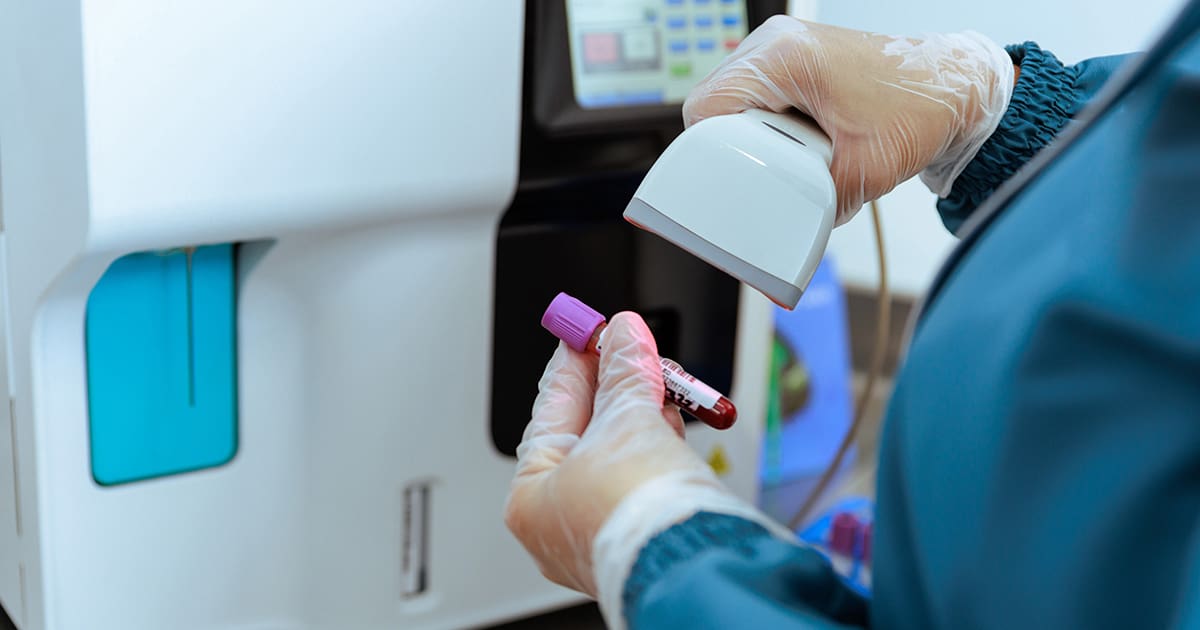
An analyst runs 40 samples on the ICP-OES, then types the results into a spreadsheet. A digit gets transposed. The QC reviewer, if there is a formal review step, may or may not catch it. If the error reaches a Certificate of Analysis or a permit report, the lab has issued a document it cannot fully defend.
Every point where a human re-keys data from one system into another is a point where the audit trail breaks. The instrument produced a result. The spreadsheet contains a number. But there is no verifiable link between the two. If a result is questioned six months later, the lab cannot prove that the number in the report matches what the instrument actually measured.
This matters beyond simple accuracy. For accredited labs, the ability to demonstrate an unbroken path from instrument output to reported result is a core requirement. When that path includes a manual transcription step with no independent verification, the traceability claim rests on trust rather than evidence.
3. Broken chain-of-custody between collection and result
Chain-of-custody means different things at different stakes. In a forensic toxicology lab, a broken chain means evidence that can be challenged in court. In a contract environmental lab, it means a sample result that cannot be tied to the field collection conditions an assessor will ask about. In a food QC lab, it means a batch release decision that cannot be traced back to the specific sample pull.
The underlying failure is the same: paper-based or inconsistent tracking of who handled the sample, when, and what happened at each transfer. A sample arrives at the lab. Someone logs it in. It moves to a prep station, then to an instrument, then to a refrigerator for retention. If any of those handoffs is undocumented, or documented inconsistently (one analyst writes the time, another doesn’t; one uses a paper form, another uses a notebook), the chain has a gap.
Assessors and auditors look for this specifically because it is one of the easiest traceability failures to find and one of the hardest to reconstruct after the fact. You either documented the transfer at the time it happened, or you didn’t.
4. Test results disconnected from method, instrument, and calibration state
When a result is questioned, the lab needs to answer several things at once: What method was used? Which version of the SOP was in effect? Which instrument generated the result? Was that instrument in calibration at the time of the run? Who performed the analysis, and were they trained and authorized for that method?
In labs running on spreadsheets, these records exist in separate places. The result is a number in a cell. The method documentation is a binder or a shared-drive folder. The calibration log is a separate spreadsheet or a paper record. The training record is in HR or in the quality manager’s files.
Individually, each record may be complete. The traceability failure is that nothing links them. An A2LA or ANAB assessor asking “was this instrument in calibration when this result was generated?” should get an answer in seconds. If it takes hours of cross-referencing, the lab’s traceability position is weaker than its individual records suggest.
5. Corrective actions tracked in email threads and meeting notes
When something goes wrong, accredited labs are required to investigate, identify the root cause, implement a corrective action, and verify that the correction worked. For ISO 17025 labs, this is not optional; it is a core requirement of the management system.
In many labs, the investigation itself is documented in email. The corrective action is assigned in a meeting and tracked on a whiteboard or in someone’s task list. The verification step, if it happens, is noted in a follow-up email. Six months later, when the assessor asks to see the nonconformance record, the lab has to reconstruct the entire sequence from scattered communications.
The problem is not that the lab failed to act. Often they did. The problem is that the investigation, the decision, and the correction are not documented in a single, reviewable, auditable record. The work happened, but the traceability of that work did not.
What changes when the lab has a system of record
Each of these five failures traces back to the same root: the lab does not have a system that connects the pieces. A LIMS (Laboratory Information Management System) is the tool designed to solve this specific problem.
When a LIMS is configured to the lab’s workflow, sample tracking from receipt to report lives in one place. Instrument results are captured electronically, with a verifiable link between the raw output and the reported value. Chain-of-custody is system-managed: every transfer is recorded with the user, the timestamp, and the reason, without relying on paper forms. Method, instrument, and calibration records are linked to the result they produced. And corrective actions are tracked in a workflow with documented ownership, deadlines, and closure, not in email.
This is not about buying software for the sake of modernization. It is about building the traceability architecture that an accredited, regulated lab needs to defend its work.
Where to start
If your lab is running on spreadsheets and paper and considering whether a LIMS would change your traceability position, the scoping conversation is straightforward. It covers your sample volume, your instruments, your accreditation status, and the specific traceability gaps that are causing friction today. LabLynx has been configuring LIMS deployments for labs in exactly this situation since 2000, and the conversation starts with your lab, not a product demo.
Accelerate Your Lab's Success & Experience LabLynx
"*" indicates required fields
Explore the LabLynx Suites
LIMS Suite
Seamless Sample and Workflow Management
The LabLynx LIMS Suite empowers laboratories with the tools needed to manage samples, workflows, compliance, and more in one centralized system. It’s the backbone for labs seeking efficient, reliable, and scalable management solutions.
ELN Suite
Organize, Record, and Innovate
The LabLynx ELN Suite offers a modern approach to managing lab data and experiments. With its secure, intuitive platform, your team can record, store, and collaborate effortlessly, supporting innovation every step of the way.
Lab Automation
Automate for Efficiency and Growth
Streamline operations and boost productivity with the LabLynx Lab Automation Suite. Designed for labs ready to embrace advanced automation, this suite integrates systems, instruments, and workflows to deliver efficiency at scale.