The Research Case for ELN Adoption in Academic Labs
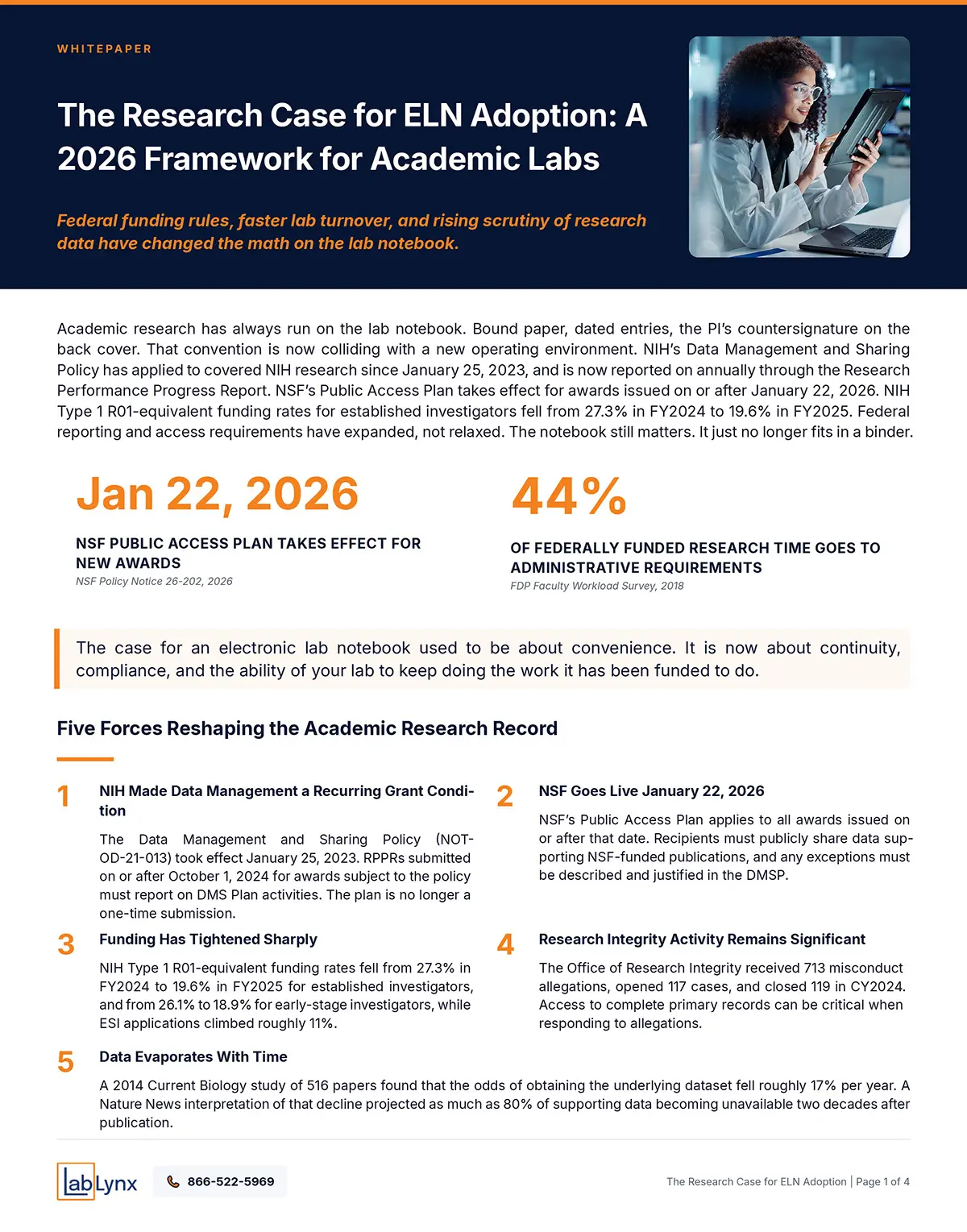
NIH's Data Management Policy, NSF's Public Access Plan, and falling federal funding rates have changed what an academic lab notebook needs to be. The pattern is visible to anyone tracking the policy timeline.
Guidance From
What NIH, NSF, and OSTP rule changes mean for academic research, why paper notebooks have become a liability, and a four-step framework for translating it into department approval.
"*" indicates required fields
Your grant terms just changed. Your notebook didn't.
NIH's Data Management and Sharing Policy applies to NIH-funded research that generates scientific data and is now reported through the annual RPPR. NSF's Public Access Plan takes effect for awards issued on or after January 22, 2026. NIH Type 1 R01-equivalent funding rates fell from 27.3% in FY2024 to 19.6% in FY2025. The requirements are not edge cases. DMS Plans become Terms and Conditions of the Notice of Award. RPPRs report on plan activities annually. Public access requires data to be findable and shareable on demand. Paper notebooks were not designed for any of it.
This paper goes inside the policy timeline: the five forces reshaping the academic research record, why the notebook question has fundamentally changed, and a four-step framework for translating it into department approval before the next funding cycle.
The federal policy reality, translated into a case your department can approve.
A practical read on what federal funders now require, what most academic labs miss in their planning, and how to make the case for an ELN before the next grant cycle starts.
Five forces reshaping the academic research record
What NIH's DMS Policy, NSF's Public Access Plan, falling funding rates, research integrity activity, and time-based data loss tell us about where academic research recordkeeping is headed in 2026.
Why the notebook question has changed
How federal funders aligned on data access through the OSTP Nelson Memo, why compliance is now an annual reporting cycle through the RPPR, and how paper documentation became a liability instead of a tradition.
A four-step framework for department approval
How to quantify the lab's current cost, map funder requirements to specific ELN capabilities, score the risks against real lab events like graduate-student turnover, and propose a phased implementation path that survives committee review.
How the LabLynx ELN fits each step
DMS Plan and RPPR support built into the data model, continuity through bench turnover, security and controlled-data handling for CMMC and IRB requirements, and FAIR alignment from day one rather than retrofitted at publication.
LabLynx Research Team
More than 25 years designing the data layer for laboratories operating under federal funding rules. This paper synthesizes NIH, NSF, and OSTP policy with patterns observed across LabLynx implementations in academic biology, chemistry, environmental science, clinical research, and engineering disciplines.
If the whitepaper makes the federal compliance picture clearer than it was, the next step is a 45-minute conversation with a LabLynx ELN specialist. Bring your active grants and the data management requirements you're working against. Leave with a clearer path from where the lab notebook is now to where it needs to be before the next funding cycle.