
Inside ISO 17025 Deficiency Data from A2LA and ANAB
A2LA's Top 10 deficiencies guide and ANAB's 2025 nonconformity data show exactly which clauses assessors cite. The pattern is visible to anyone who reads either list carefully.
Guidance From
What A2LA's Top 10 and ANAB's 2025 data say, why the findings keep recurring, and what a modern LIMS does to close the gap.
"*" indicates required fields
What auditors will cite at your next assessment is already published. Most labs haven't read it.
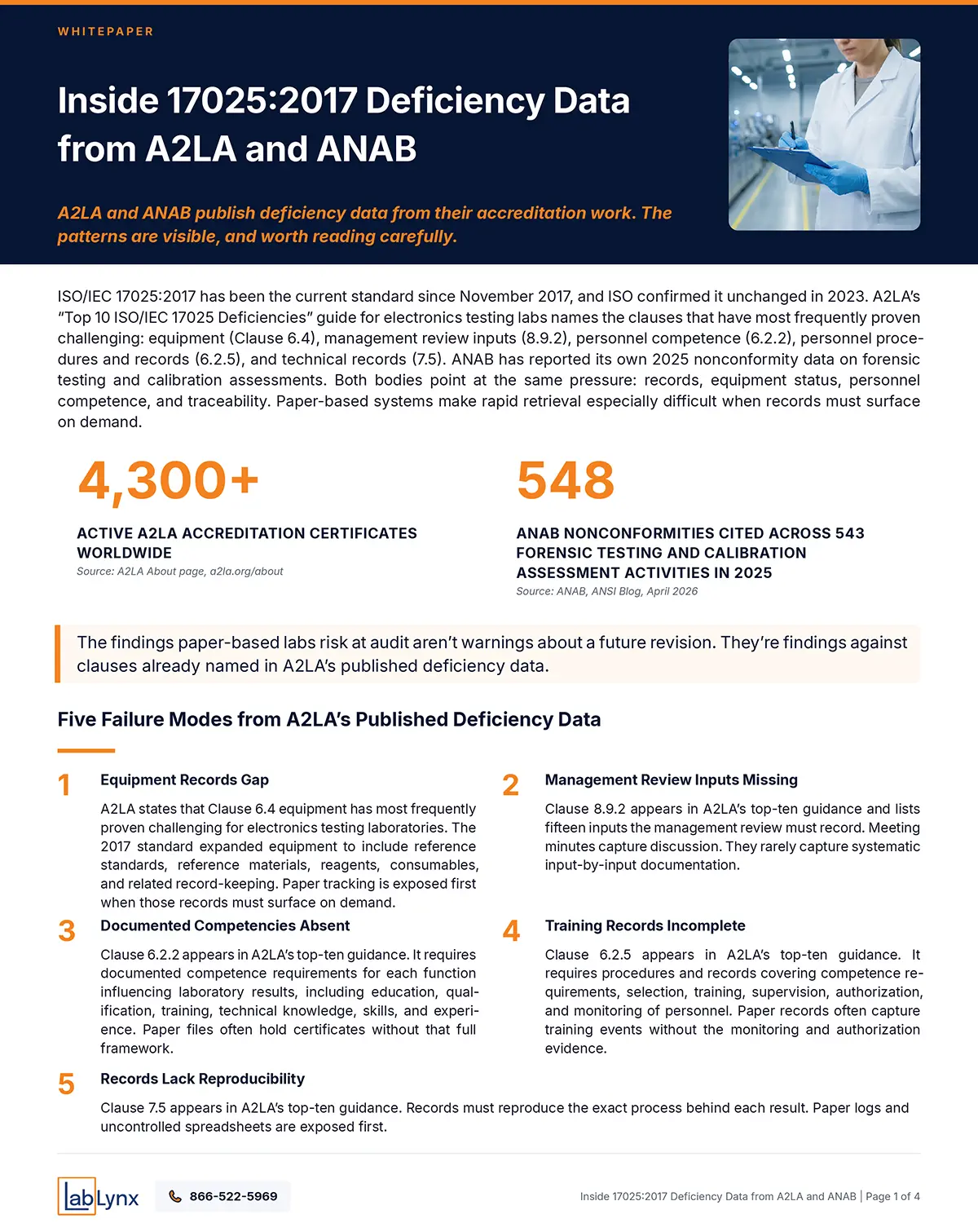
A2LA publishes its Top 10 deficiencies for ISO/IEC 17025, ANAB reports 548 nonconformities across 543 forensic testing and calibration assessments in 2025, and both bodies point at the same pressure. The findings that recur are not edge cases. Equipment, management review inputs, documented competencies, training records, and technical records all require continuous, retrievable evidence that paper-based and spreadsheet-based workflows cannot produce on demand.
This paper goes inside the data: the five failure modes A2LA names, why the same findings keep recurring across both datasets, and what a modern LIMS does to close the gap before the next reassessment lands.
The deficiency data, decoded for the lab that has to act on it.
A practical read on what the data actually says, what most labs miss in reading it, and what changes when a modern LIMS sits behind the work.
Five failure modes from A2LA's published deficiency data
What A2LA's Top 10 says about the way labs actually handle their evidence base, and why the recurring failure modes are structural, not procedural.
Why the same findings keep recurring
The structural reason the same deficiencies repeat across assessment cycles, and what ANAB's 2025 data confirms across forensic testing and calibration. It isn't about process discipline.
How findings cascade past the audit
How the LabLynx LIMS closes each gap
Six capabilities mapped to the five failure modes, and why most of them aren't what a paper-heavy lab expects to find on a LIMS feature list.
LabLynx Research Team
More than 25 years designing the data layer for accredited testing and calibration laboratories. This paper reads A2LA's and ANAB's published deficiency data against patterns observed across hundreds of LabLynx implementations in environmental testing, forensic science, clinical diagnostics, pharmaceutical research, and manufacturing quality control.
If the whitepaper makes A2LA's and ANAB's findings clearer than they were, the next step is a 45-minute conversation with a LabLynx compliance specialist. Bring the clauses cited at your last assessment, and the ones you're least confident about for the next one. Leave with a short list of what matters most before the same finding shows up twice.