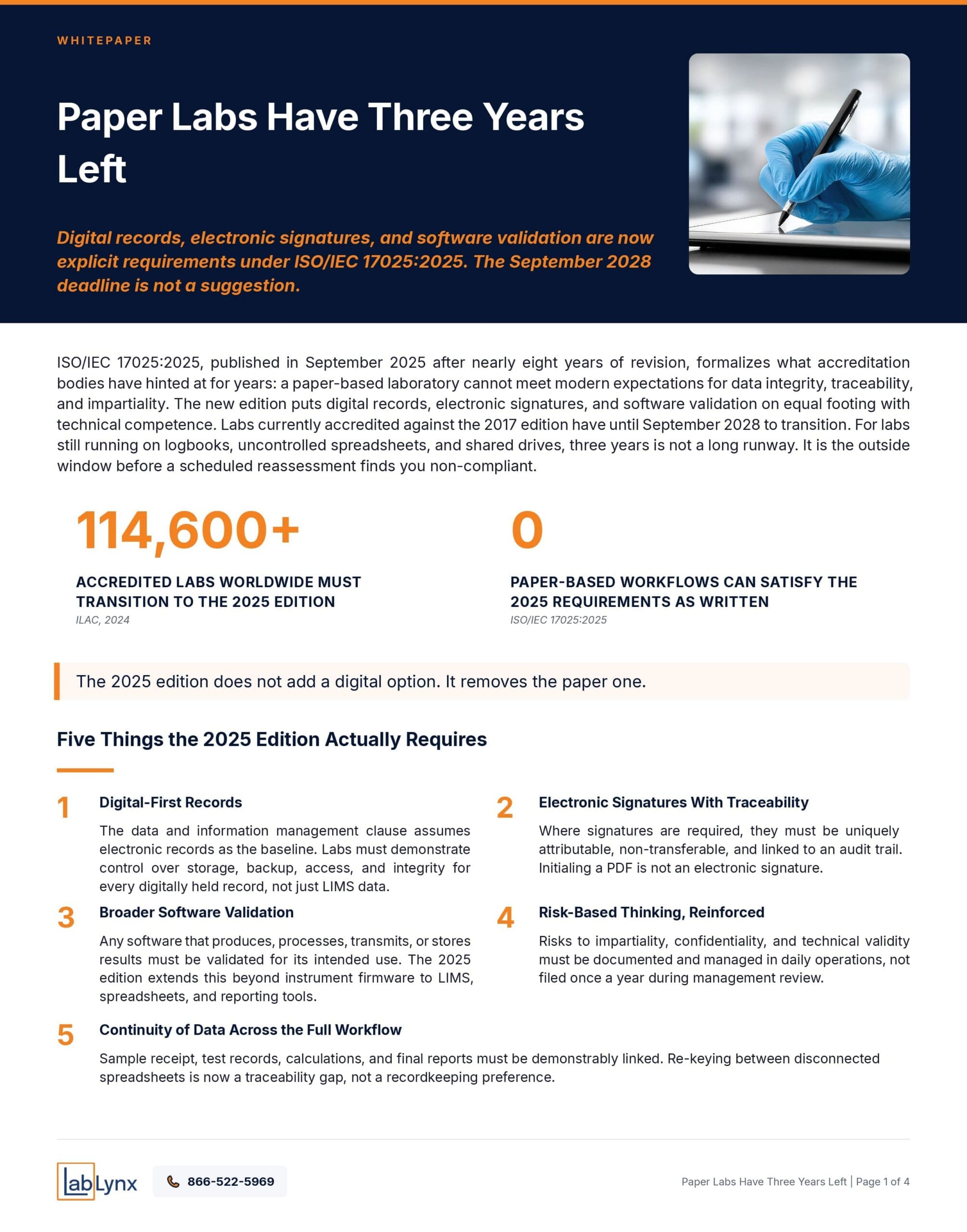
Paper Labs Have Three Years Left
Digital evidence, broader software validation, and operational risk decisions now carry the weight of reassessment, with a September 30, 2028 deadline already running.
Guidance From
What the 2025 edition changed, why the runway is shorter than it sounds, and what a modern LIMS has to do to meet the new bar.
"*" indicates required fields
The 2017 edition retires in September 2028. The work to replace it starts now.
ISO/IEC 17025:2025 is published, the three-year transition is running, and most reassessments scheduled for 2027 and beyond will be conducted against the new edition. The changes that matter are not cosmetic. Expanded data and information management, software validation that reaches well past the LIMS, and risk-based thinking inside daily operations all require evidence that paper-based and spreadsheet-based workflows cannot produce on demand.
This paper lays out what actually changed from 2017 to 2025, why the transition runway is shorter than it sounds, and what a modern LIMS has to do to meet the new bar before the September 30, 2028 deadline closes.
The transition plan, built for the lab that has to run one.
What the 2025 edition actually requires
Five practical requirements, separated from the cosmetic changes. Digital-first records with full control over storage and integrity. Electronic signatures with traceability. Software validation that reaches beyond instrument firmware. Risk-based thinking in daily operations. Continuity of data across the full workflow.
Why the runway is already shorter than it sounds
The cadence of accreditation body transitions, the global alignment under the new GAC framework, and the cascade from ISO 17025 into FDA, EPA, and client audits. Why most reassessments scheduled for 2027 and beyond will be conducted against the new edition.
Where paper and spreadsheet workflows fall short
Why audit trails, electronic signatures, software validation, and end-to-end data continuity have no paper equivalent. What an auditor cannot verify from a stack of logbooks, and what the 2025 edition requires in its place.
How a modern LIMS maps to the 2025 edition
The capabilities a modern LIMS was designed to provide, aligned clause by clause with the new requirements. Digital records by default, 21 CFR Part 11-aligned signatures, validated software with evidence, and end-to-end traceability from sample receipt to final report.
LabLynx Research Team
Twenty-eight years designing the data layer for accredited testing and calibration laboratories. This paper distills observations from hundreds of implementation engagements across environmental testing, forensic science, clinical diagnostics, pharmaceutical research, and manufacturing quality control.
If the whitepaper makes the scope of the transition clearer than it was, the next step is a 45-minute conversation with a LabLynx compliance specialist. Bring your current evidence pack and the clauses you are least confident about. Leave with a short list of what matters most before your next reassessment.