
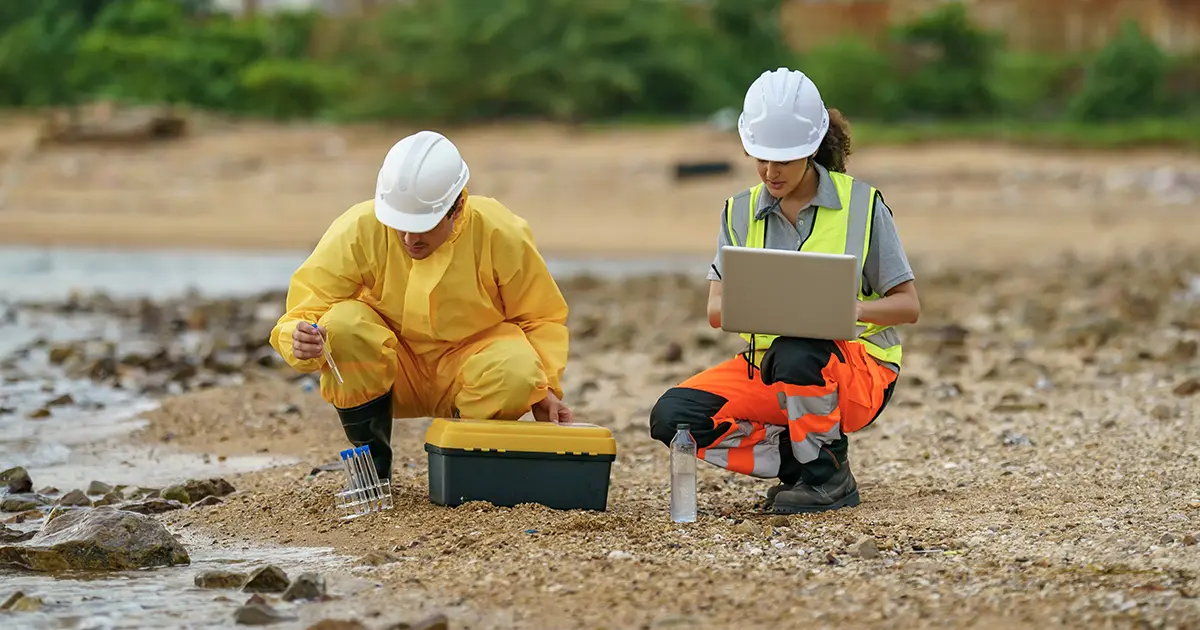
Environmental testing labs face a unique challenge that can make or break their credibility: maintaining an unbroken chain of custody for hundreds or thousands of samples each month. A single gap in documentation can invalidate test results, derail legal proceedings, and damage your lab’s reputation. When you’re processing 1000+ samples monthly, the stakes—and the complexity—multiply exponentially.
This guide shows you how high-volume environmental labs maintain defensible chain of custody without drowning in paperwork or hiring additional staff.
What Is Chain of Custody (And Why It’s Non-Negotiable)
Chain of custody (CoC) is the chronological documentation that tracks sample handling from collection through disposal. It proves that samples were properly controlled at every step, making test results legally defensible.
For environmental labs, chain of custody documentation must answer four critical questions at every transition point:
- Who handled the sample?
- What did they do with it?
- When did the transfer occur?
- Where is the sample now?
This documentation isn’t optional. Environmental samples often support regulatory enforcement, litigation, or compliance verification. Courts, EPA auditors, and regulatory agencies will reject results if chain of custody has gaps or inconsistencies.
The High-Volume Challenge: Where Manual Processes Break Down
Managing chain of custody for 50 samples per month is tedious but manageable with paper forms and spreadsheets. At 1000+ samples monthly, manual processes become a liability.
Common Breaking Points in High-Volume Labs
Illegible handwriting on chain of custody forms. Field technicians fill out CoC forms in challenging conditions—rainy weather, cramped vehicles, wearing gloves. When receiving staff can’t read critical information, they must track down the collector for clarification, delaying processing.
Missing or incomplete signatures. Each sample transfer requires a signature from both the relinquishing party and the receiving party. In high-volume operations, rushed technicians forget to sign, or receiving staff batch-sign forms without verifying each sample, creating documentation gaps.
Sample identification mismatches. Labels get damaged, handwritten sample IDs are transcribed incorrectly, or samples are mislabeled at collection. Reconciling these discrepancies consumes hours of staff time and can delay reporting by days.
Lost custody forms. Paper forms get separated from sample coolers, misplaced during internal transfers, or damaged during transport. Reconstructing chain of custody after the fact is time-consuming and creates questions about data integrity.
No visibility into sample status. Project managers and clients frequently call asking “Where is my sample?” Staff must physically search for samples or dig through paperwork to answer, interrupting laboratory workflows multiple times daily.
Storage location tracking failures. Samples move between receiving, preparation, testing, and storage. In high-volume labs, samples can be temporarily “lost” because no one documented the current storage location.
Best Practices for Chain of Custody at Scale
Environmental labs that successfully manage high sample volumes implement these core practices:
Standardize Sample Identification
Use a consistent, structured sample ID format across all projects. Include project identifier, collection date, sample type, and sequence number. For example: ENV-2026-0211-SW-001 (Environmental project, collected February 11, 2026, surface water, sample 1).
Pre-print sample labels when possible, or use barcode labels generated at collection. This eliminates transcription errors and makes samples instantly identifiable.
Implement Receiving Checklists
Create a standardized receiving protocol that verifies:
- Sample cooler seal integrity and temperature
- Presence of complete chain of custody form
- Physical samples match listed samples on CoC
- Sample containers are intact and properly labeled
- Preservation and holding times are within limits
Document discrepancies immediately and notify the client before samples enter the lab workflow.
Establish Clear Custody Transfer Points
Define exactly when custody transfers occur in your lab:
- Collection to courier
- Courier to receiving staff
- Receiving to sample prep
- Sample prep to analytical section
- Analytical section to storage
- Storage to disposal
Each transfer must be documented with names, dates, times, and signatures.
Use Physical Security Controls
Maintain sample security between custody transfers:
- Locked storage areas with access logs
- Refrigerators and freezers with temperature monitoring
- Secure sample prep and testing areas
- Controlled access to archives
Security measures prevent unauthorized access and support the defensibility of your chain of custody.
Create Sample Location Maps
Assign specific storage locations (shelf, refrigerator number, rack position) to samples and document locations at each transfer point. This prevents the “lost sample” problem and speeds retrieval for additional testing.
When Volume Demands Automation: Moving Beyond Paper
The practices above work—but at 1000+ samples monthly, manual implementation requires significant staff time and still leaves room for human error. High-performing environmental labs increasingly use laboratory information management systems (LIMS) to automate chain of custody tracking.
How LIMS Transforms Chain of Custody Management
Barcode scanning eliminates transcription errors. Each sample gets a unique barcode at collection or receiving. Staff scan barcodes at every custody transfer point, automatically recording who handled the sample, when, and where it’s located. No handwriting to decipher, no data entry mistakes.
Electronic signatures create defensible audit trails. Instead of collecting wet signatures on paper forms, LIMS captures electronic signatures with user authentication, timestamps, and the reason for transfer. These digital signatures meet regulatory requirements and create an unalterable audit trail.
Automated alerts prevent holding time violations. LIMS tracks sample collection dates and method-specific holding times, alerting staff when samples approach their analysis deadline. This prevents regulatory violations and reduces the need for sample resampling.
Real-time location tracking. As samples move through the laboratory workflow, LIMS automatically updates their status and location. Project managers and clients can view sample progress in real-time through web portals, eliminating “where is my sample” phone calls.
Automatic chain of custody documentation. LIMS generates complete chain of custody reports on demand, pulling from the electronic audit trail. These reports show every person who handled each sample, every transfer time, and every location change—all in a clean, professional format ready for regulatory submission.
Exception flagging and resolution tracking. When receiving staff identify discrepancies (damaged container, missing sample, temperature excursion), LIMS documents the exception, triggers notifications to appropriate personnel, and tracks resolution. This ensures nothing falls through the cracks.
The Efficiency Gain: Quantifying the Impact
Environmental labs that implement LIMS for chain of custody typically report:
- 60-80% reduction in time spent on chain of custody documentation
- Near-elimination of sample identification errors
- 90%+ reduction in “where is my sample” inquiries
- Faster sample processing due to elimination of data reconciliation
- Improved audit readiness with instantly available, complete documentation
For a lab processing 1000 samples monthly, this efficiency gain translates to hundreds of staff hours returned to value-adding activities like testing and client communication.
Implementation Roadmap: Starting Your Chain of Custody Modernization
If you’re ready to move beyond manual chain of custody management, here’s how to approach the transition:
Step 1: Document Your Current Process
Map your existing chain of custody workflow from sample collection through disposal. Identify every custody transfer point, who’s responsible, and how information is currently captured. Note specific pain points and bottlenecks.
Step 2: Define Your Requirements
Determine what your chain of custody system must do:
- What sample types and matrices do you handle?
- What regulatory requirements must you meet (EPA, state programs, accreditation bodies)?
- What integrations do you need (instruments, client portals, billing systems)?
- What reports must you generate?
Step 3: Choose Your Technology Approach
Evaluate whether you need:
- Simple barcode tracking system
- Standalone chain of custody software
- Full laboratory information management system (LIMS)
Most environmental labs processing 1000+ samples monthly benefit from a complete LIMS that handles chain of custody alongside sample management, data tracking, and reporting.
Step 4: Pilot with One Sample Type or Project
Start with a single sample matrix or client project. Get the system working smoothly for a subset of your samples before expanding to your full operation. This phased approach reduces risk and allows staff to build competency gradually.
Step 5: Measure and Optimize
Track key metrics before and after implementation:
- Time spent on chain of custody documentation per sample
- Number of chain of custody discrepancies
- Sample turnaround time
- Staff time spent answering status inquiries
Use this data to refine your processes and demonstrate ROI to management.
Chain of Custody Compliance: Regulatory Considerations
Your chain of custody system must meet regulatory requirements for your specific testing programs. Key standards include:
EPA guidelines. Methods often specify chain of custody requirements, particularly for drinking water and hazardous waste testing. Electronic records and signatures must meet EPA’s Cross-Media Electronic Reporting Rule (CROMERR) if you submit data electronically.
State program requirements. Many states have specific chain of custody requirements for environmental testing. Review applicable state regulations before implementing any new system.
Accreditation standards. If your lab is accredited under ISO/IEC 17025, TNI, or state programs, your chain of custody system must meet accreditation body requirements for sample tracking and documentation.
Legal defensibility. For samples supporting litigation or enforcement, courts require demonstration that chain of custody was maintained throughout. Your system must create records that withstand legal scrutiny.
When evaluating laboratory information management systems, verify that the system is designed to meet these regulatory requirements and can produce compliant documentation.
The Bottom Line: Chain of Custody Is Your Lab’s Foundation
At 1000+ samples monthly, chain of custody management separates efficient, credible environmental labs from those struggling with errors, delays, and audit failures. Manual processes that worked at lower volumes become bottlenecks and liability risks at scale.
The investment in modernizing chain of custody—whether through improved manual processes or automation through LIMS—pays for itself through:
- Reduced staff time on documentation and reconciliation
- Fewer errors requiring investigation and corrective action
- Faster sample turnaround times
- Improved audit readiness and reduced audit preparation time
- Better client satisfaction through real-time sample visibility
Most importantly, robust chain of custody protects the integrity and defensibility of your test results—the core product of your laboratory.
Next Steps: Evaluating Your Chain of Custody System
Take stock of your current chain of custody processes by asking:
- How much staff time do we spend on chain of custody documentation weekly?
- How often do we encounter sample identification errors or missing custody information?
- Can we instantly locate any sample in our lab and provide its complete custody history?
- How long does it take to prepare chain of custody documentation for an audit or legal proceeding?
- What would happen to our operations if our sample volume doubled?
If any of these questions reveal weaknesses in your current system, it’s time to evaluate modernization options. The right laboratory information management system doesn’t just track chain of custody—it transforms it from a paperwork burden into a competitive advantage.
LabLynx provides laboratory information management systems specifically designed for environmental testing labs, with comprehensive chain of custody tracking, electronic signatures, and regulatory compliance features. Our systems scale from hundreds to hundreds of thousands of samples, maintaining the same level of traceability and data integrity regardless of volume.
Ready to see how automated chain of custody could work in your lab? Contact our team to discuss your specific requirements and see a demonstration tailored to environmental testing workflows.
Accelerate Your Lab's Success & Experience LabLynx
"*" indicates required fields
Explore the LabLynx Suites
LIMS Suite
Seamless Sample and Workflow Management
The LabLynx LIMS Suite empowers laboratories with the tools needed to manage samples, workflows, compliance, and more in one centralized system. It’s the backbone for labs seeking efficient, reliable, and scalable management solutions.
ELN Suite
Organize, Record, and Innovate
The LabLynx ELN Suite offers a modern approach to managing lab data and experiments. With its secure, intuitive platform, your team can record, store, and collaborate effortlessly, supporting innovation every step of the way.
Lab Automation
Automate for Efficiency and Growth
Streamline operations and boost productivity with the LabLynx Lab Automation Suite. Designed for labs ready to embrace advanced automation, this suite integrates systems, instruments, and workflows to deliver efficiency at scale.