Free guidee-book
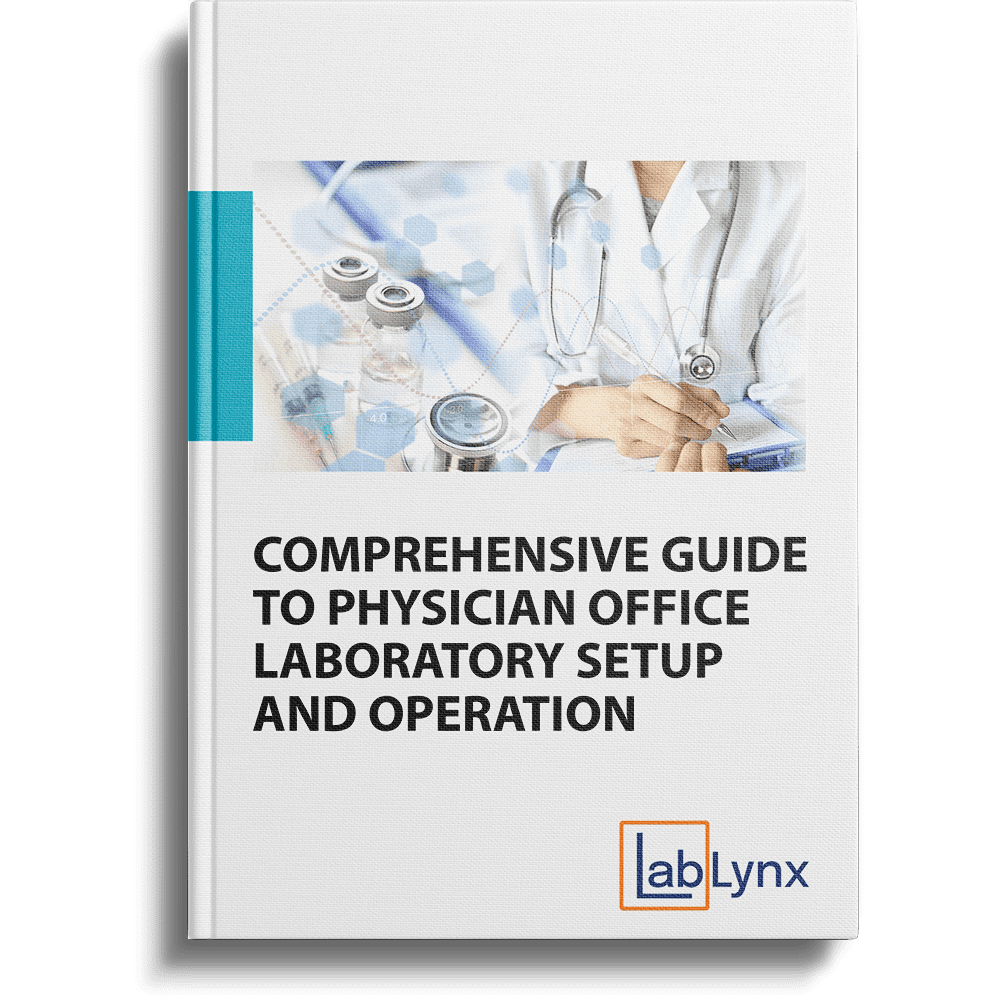
Comprehensive Guide to Physician Office Laboratory Setup and Operation
A free LabLynx e-book on starting and running a physician office laboratory, from CLIA certificates and waived testing to data management, staffing and quality.
Get your free copy
- e-book
- Instant download
"*" indicates required fields
We also email you the link.
A physician office laboratory (POL) is a clinical laboratory maintained by a physician, partnership or group as part of a practice, usually in the office itself, that tests patient specimens to diagnose, prevent or treat disease. This LabLynx guide covers starting and running one: CLIA certificates and waived testing, the main testing domains, data management, staffing and quality.
What you will learn
- What a POL is, and how it differs. A smaller clinical lab running simple, rapid tests, most of them CLIA-waived.
- Which CLIA certificate fits your testing. Waived testing, provider-performed microscopy, and what each means for the lab director.
- The tests a POL typically runs. Urinalysis, hematology, clinical chemistry, immunology, toxicology and molecular diagnostics.
- How to manage the lab's data. Workflow first, then whether the practice needs the patient chart, an EHR, middleware or an LIS.
- How to staff it and keep quality high. Training, certification, accreditation, SOPs and proficiency testing, even in a waived lab.
What is inside the guide
From what a POL is to who should run it, followed by resource lists for the practice: here is what the guide covers.
The POL as a clinical laboratory
A POL is usually a smaller operation than a reference or diagnostic lab, running simple tests that produce useful diagnostic data cheaply and rapidly. The guide cites CMS figures from May 2022: about 40 percent of U.S. clinical labs were POLs, and most of them held a certificate of waiver.
Good laboratory practice, safety and patient privacy
Good practice runs through every stage of testing, from reviewing the order to disposing of waste and documenting the result in the patient record. The guide covers CDC and OSHA safety training, HIPAA's protection of patient health information, and the 2014 change that lets patients request their results directly from the lab.
Go deeper: HIPAA compliance in the laboratory
CLIA certificates, waived testing and PPM
CLIA assigns tests and devices one of three complexity levels (waived, moderate or high), and a lab must hold a certificate that matches the testing it performs. The guide explains the certificate of waiver most POLs run on, the provider-performed microscopy (PPM) certificate for microscope-based tests, and what each means for the lab director.
Go deeper: CLIA compliance in the laboratory
Point-of-care testing and market trends
Point-of-care testing happens near or at the patient, and it has become a significant source of testing for the POL. The guide traces how waived tests grew more sophisticated, up to the first waived molecular tests, and how pharmacy-based labs became competitors for waived testing.
The economics of the POL
Billing, insurance reimbursement, profitability and return on investment are closely tied, and the practice must decide which tests to offer. The guide explains why ROI is hard to measure when benefits such as patient satisfaction are qualitative, and how reimbursement changes, from Medicare's 2010 drug-panel billing rule to PAMA, affect small labs.
The main testing domains
The guide gives urinalysis, hematology, clinical chemistry, immunology, toxicology and molecular diagnostics a section each, from collection procedures and reference ranges to the tests and devices available. For each, it shows which testing a waived lab can do and which needs a higher CLIA certificate.
Workflow and data management
Data management starts with the workflow: collection, receiving, preparation, analysis, post-processing and reporting, plus tasks such as ordering inventory and maintaining CLIA requirements. A waived POL running a handful of tests may only need results entered in the patient chart or EHR, while one doing moderate and complex testing in volume may need a laboratory information system (LIS).
Go deeper: LIS vs LIMS
Connecting instruments, the LIS and the EHR
Interfaces between instruments, an LIS and an EHR rest on standards such as HL7 and FHIR, and they are rarely turnkey. The guide weighs a full LIS against an EHR with lab functions added and against middleware that sends instrument data straight to the EHR, which may suit a POL with low test volumes.
Go deeper: Lab instrument integration
Best practices, SOPs and quality management
Information management software will not improve patient and test management on its own, and in most small POLs the office manager or a physician takes that work on. The guide lists the duties that shape standard operating procedures and covers quality control, from Westgard rules and Levey-Jennings plots to reporting and inventory.
Staffing, training and accreditation
CLIA's Subpart M sets personnel requirements for non-waived labs, and some states add staffing, education or licensing rules of their own. The guide lists individual certifications and lab accreditors such as COLA and CAP, and explains why a waived lab should still train its staff, write its procedures down and join a proficiency testing program.
Go deeper: CAP accreditation for laboratories
Key takeaways
- Most POLs run simple, waived tests. The guide cites CMS figures from May 2022: 70.6 percent of non-exempt POLs held a CLIA certificate of waiver, 17.5 percent a PPM certificate and 11.9 percent a certificate for moderate- or high-complexity testing.
- The certificate sets the test menu. A urine dipstick needs only a certificate of waiver; microscopic urinalysis needs a PPM certificate; most complete blood counts, advanced chemistry panels and molecular tests need a higher one.
- Waived does not mean exempt from quality. Waived labs are not subject to CLIA's personnel, quality control and proficiency testing rules, yet the guide urges training, written procedures, quality assessment and proficiency testing anyway.
- Let the workflow decide the data tools. A small waived lab may need only the patient chart or EHR; higher-volume, non-waived testing can justify an LIS; middleware can link instruments to the EHR without one.
- Someone has to take the lead. Whatever the lab's CLIA classification, someone should own its operations: documented procedures, quality management and proficiency testing.
The POL workflow
Specimen collection. The physician, nurse or office assistant collects what the ordered test needs; venous blood and urine take more steps than a finger-stick.
Specimen receiving. At the point of care there is little to receive; specimens not tested at the patient's side need labels, barcodes and an entry in the lab's records.
Specimen preparation. Venous blood, for example, may need centrifuging and the serum or plasma pipetted off as an aliquot.
Processing and analysis. A waived device does the analysis itself, sometimes in minutes; moderate or complex testing adds reagents, an analyzer or a manual review.
Post-processing. Anything from disposing of a waived test strip properly to storing part of a specimen in case more analysis is needed.
Reporting. Often just documenting the result in the patient chart; a few results, such as a positive HIV test, may also have to be reported to local and state authorities.
Who it is for
Physicians and practice managers
who are weighing whether an in-office lab is worth the effort, and what it takes to start one well.
POL directors and office managers
who answer for compliance and need to know what their CLIA certificate asks of the lab and its staff.
Laboratorians and office staff
who collect specimens and run tests, and want the procedures, quality practices and training paths a POL relies on.
Written for Physician office laboratories, from small waived labs to larger group practices running moderate-complexity testing, and other point-of-care sites such as urgent care clinics and pharmacy-based labs.
What does the guide say a CLIA certificate of waiver lets a POL do?
How does the guide say a waived lab should approach quality?
What does the guide say about who can direct a POL?
Which tests does the guide say are most common in a POL?
Does the guide say a POL needs a laboratory information system?
How does the guide suggest a POL build its standard operating procedures?
More free guides
 Free guideThe Ultimate Guide to Laboratory ComplianceNavigate the complex world of lab regulations with confidence. This guide breaks down key standards across industries including clinical, pharma, food, and environmental, helping labs stay audit ready, improve quality, and protect data. It is a must-have resource for building a safer, smarter, and fully compliant lab operation.Get this free guide
 Free guideHIPAA Compliance: An IntroductionNew to HIPAA? This free introductory guide explains what counts as protected health information, the rules on its use and disclosure, and the administrative requirements and security standards that apply to laboratories, so your team can safeguard patient data and meet its regulatory obligations.Get this free guide
 Free guideLaboratory Informatics Buyer’s Guide for Medical Diagnostics and ResearchChoosing informatics for a medical lab? This free guide profiles clinical, public health, research and physician office labs, weighs the options for managing their data against cost, security and regulation, and walks from a requirements specification and RFI to vendor demos and a final choice.Get this free guide
Free guide
Comprehensive Guide to Physician Office Laboratory Setup and Operation
e-book
- What a POL is, and how it differs
- Which CLIA certificate fits your testing
- The tests a POL typically runs